
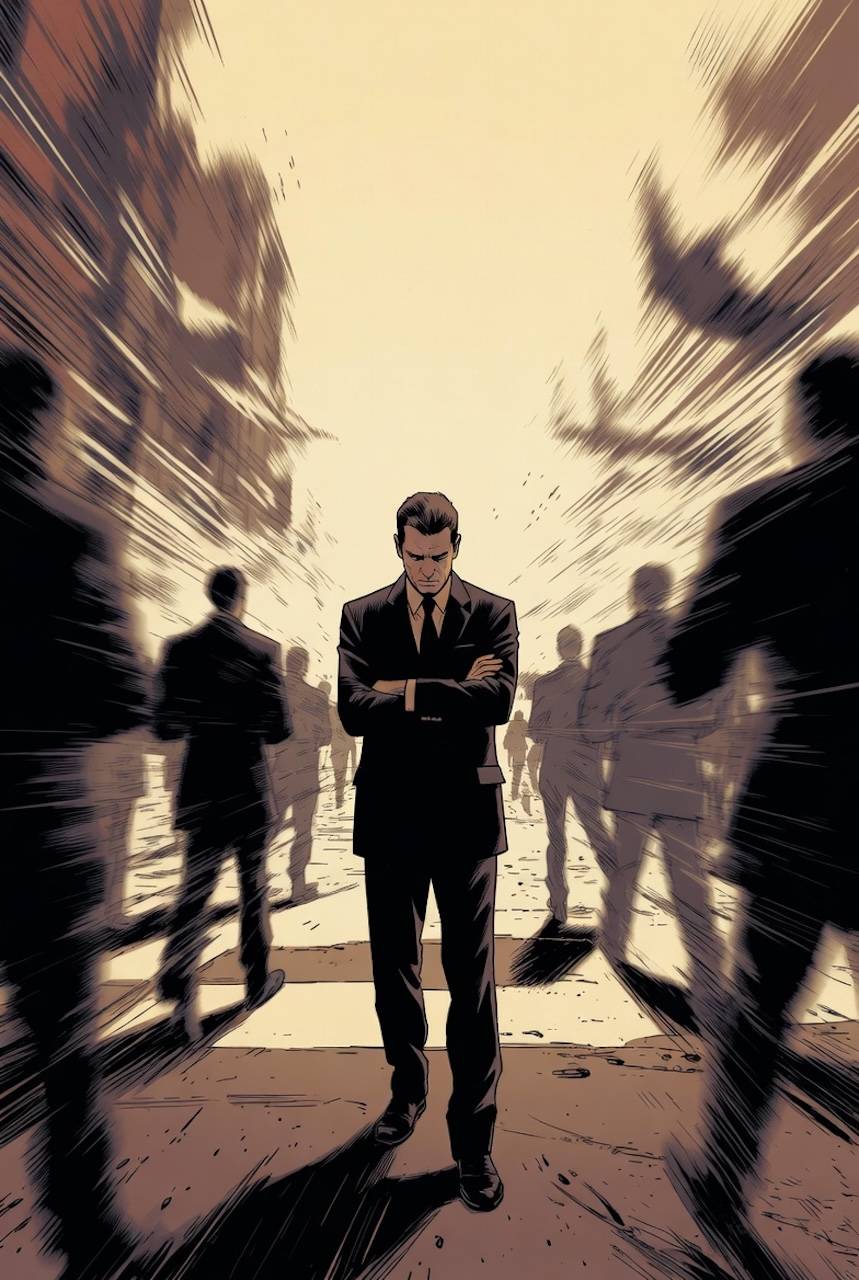
And that addiction is quietly costing you the one life you get.

In cybersecurity, there’s no such thing as zero risk. There’s only the risk you manage consciously and the risk you ignore until it bites you. I lead cybersecurity teams for the Government of Canada. We don’t chase zero risk. We evaluate, mitigate what we can, we decide., and we move forward.
This idea also directly applies to your career, yet most people are getting it catastrophically wrong.
Mid-career professionals stay stuck in work they hate because they’ve convinced themselves it’s the safe play. It isn’t. They’re just ignoring the risks they can’t see: the creeping burnout, the erosion of purpose, the slow drift away from the person they were supposed to become.
They’ve become certainty-addicted.
And right now, with AI reshaping work, economic and geopolitical uncertainty rising, and entire professions being reinvented in real time, that addiction to the status quo is quietly becoming one of the highest-risk positions you can take.
There is no free lunch with risk. Ever. Just trade-offs.
When you stay handcuffed to a job that no longer serves you, you’re taking on enormous risk, regardless of whether you’re aware of it. These risks feel too scary to even look at, so you ignore them. You put your head in the sand and call it being prudent. You tell yourself it’s the responsible thing for your family, your mortgage, your reputation. That it’s just what responsible adults do.
Meanwhile, those silent, sneaky risks keep compounding: the slow soul erosion, the quiet obsolescence, the version of you that shows up at home as a half-present ghost. Most people never see it coming until it’s already happened. That’s a quiet epidemic of people who woke up one day and realized they’d traded their one shot at a life that felt alive for a paycheck that felt safe.
I see this behaviour all the time, and as a risk management professional, it gets to me. People I consider smart and strategic blindly carry these risks in their careers, deluding themselves into thinking that they’re safe.
But the world has upped the ante. The risks continue to grow.
And the stakes just went up. AI is reshaping roughly 40% of jobs, according to some recent data. Economic and geopolitical volatility is accelerating.
The head-in-the-sand strategy—“let’s just keep doing what we’ve always done”—is no longer low-risk. It’s the new exposure. Work is being reinvented as we speak. Standing still isn’t stability anymore. It’s dangerous.
You’re not risk-averse.
You’re certainty-addicted.
And the addiction is costing you the life you actually want.
So what do you do about it?
You treat your career the same way I treat cybersecurity risks at work: honestly, systematically, and without bringing along all your personal bullshit, which you conveniently use to cloud the truth.
If you’re ready to face the career risks you’re exposed to, and do something about it, here’s an exercise you can run; something I call the “Certainty Detox Protocol”. Four weeks. Tiny, reversible steps. No leaps off cliffs. Just enough to prove to yourself that you can handle the unknown without everything falling apart.
The Certainty Detox Protocol
Week 1: Risk Register Flip (30 minutes)
Grab a piece of paper or a simple spreadsheet. Do this like the real thing—no fluffy journaling.
Take 10-15 minutes to reflect on what some of the “invisible risks” might be that you’re facing in your career, putting each one into a new row on your spreadsheet. To help you come up with this list, consider what your life would look like in 5 years if you keep living and working as you are today. After you’ve got your list, reflect on each one of them and note the following:
- Probability (1–5: how likely over the next 12–24 months?)
- Impact (1–5: how badly would it actually hurt your one shot at life?)
- Risk score (probability × impact)
- Current mitigations (what you’re already doing—be brutally honest; most people write “nothing” here)
- Residual risk (what’s left after your mitigation)
This exercise will help open your eyes to how risky your “safe” position actually is.
Week 2: One Reversible Bet
Pick one low-visibility experiment that costs you almost nothing to try and almost nothing to walk away from. Examples:
- Spend two hours shadowing a different team or role inside your org.
- Run one AI-assisted side project on a topic that lights you up.
- Have the scary 15-minute conversation with your boss about evolving one piece of your mandate.
Open up your “risk register” that you’d created last week. Do the same exercise for this small experiment you’re thinking of running. My bet is that you’ll find that running it poses very little risk at all, despite how scary it might feel to you. Documenting the risks will help you see clearly whether or not you should be trying the experiment or if it is riskier to just stay stuck where you are.
Then actually run the experiment. Document three things: what happened, how it felt, and what data it gave you. That’s it. One bet. Easily reversible. Proof starts here.
Week 3: Certainty Audit
Create a new note on your phone. For one week, every time you have the thought “I would like to do that, but I can’t right now” or “maybe next year,” take note of it. Then force yourself to finish the thought with: “What data would prove this is still the right risk choice?”
At the end of the week, review your notes. Most people discover they’ve been running on autopilot certainty for years, never moving forward on what they actually want, as they’re living in fear, believing that it’s “too risky” right now, or that they’ll do it later.
This week breaks the trance.
Week 4: Skill Redirection
Take one of your strengths you’ve over-optimized in your current role (the thing you’re “too damn good at”) and deliberately repurpose 10% of your time to test it in a direction that feels more soul-aligned. Same skill, different arena. You’re not throwing anything away, but redirecting the skill in a new and interesting way as an experiment.
Wrapping Up the Certainty Detox
Four weeks. Tiny, reversible moves. At the end of it, you’ll have something most people never get: concrete evidence that you can trust yourself in the unknown.
You don’t need permission. You need proof.
The risk isn’t the leap. The risk is pretending you can stay still, while the world around you changes.