
Better Problems

For months, I complained about a project that wasn’t mine.
It was an IT infrastructure rollout in a large government department, and it was failing. Miserably. Everyone complained about it. The work kept going anyway, because it had to get done.
I had plenty of reasons to join in with the complaints. The project was causing problems for my team, and it sat outside my expertise. I led a data analytics team, while this project was pure IT infrastructure. Nobody expected me to get involved.
Eventually, I decided to do something about it.
I went to the executive who owned the project and told them what I was seeing. I described where the problems were, what people were saying about the rollout, and a few ideas for approaching it differently. I was upfront that I wasn’t an infrastructure expert. My goal was to be useful.
After hearing me out, the executive asked if I would take over the project.
That wasn’t what I had expected.
It was a lateral move, so there was no promotion or pay raise. The upside was the chance to learn something new. The downsides were obvious: a high-profile project already on fire, moving to a new division, reporting to a new boss, working with a team I had never managed before, and doing all of this in a domain where I did not consider myself an expert.
I hesitated. But I’d spent months complaining about this project from a safe distance. Complaining was easy. If I thought I could fix it, this was the time to find out.
So I decided to jump in.
The work was hard. People were frustrated, the project already had a bad reputation, and I had a lot to learn quickly. I changed the approach. I used my analytics background to give each division’s management clear data on the rollout, which made it obvious which parts of the organization were delivering and which weren’t. That transparency, reported up through governance, changed behaviour. Over time, we got the project back on track and delivered it.
What happened afterward mattered more.
My CIO had known me as someone who could lead data analytics work. Now they had seen me step into an unfamiliar domain, make sense of a complicated situation, and get a stalled project moving again.
That changed the work I was given. I got more interesting assignments and a reputation for figuring out complicated things. Later, I was promoted into an executive role leading larger and harder infrastructure projects.
Nobody handed me that path. It opened because I stopped complaining long enough to take ownership of a gnarly problem and make it better.
The promotion was the Job payoff. The bigger payoff was the capacity I built: walking into a mess I didn’t understand and making it work. That part was mine, and it came with me when I left government.
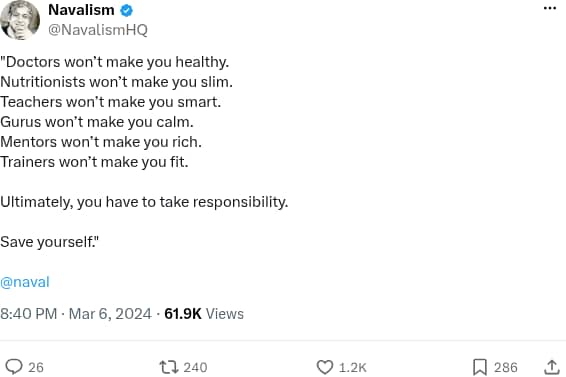
As Naval put it: “Ultimately, you have to take responsibility. Save yourself.”
We usually treat responsibility as a burden, or as another word for blame. When something goes wrong, the first question is who was responsible: who caused it, and who has to answer for it.
Theologian H. Richard Niebuhr framed responsibility as a response back in the 1960s. Stephen Covey later popularized it as “response-ability”: your ability to respond. It still holds up.
The project I inherited wasn’t broken because of me. I hadn’t designed it, managed it, or created its problems. Once I saw the situation clearly, I had a choice about how I responded to it.
You are not responsible for everything that happens to you. You are responsible for what you do next.
Do you get better information? Push back? Ask for help? Walk away?
Choosing how you respond is where your agency sits.
Choose your messes carefully
Taking responsibility expands what you’re trusted to do. When people see you take a messy, ambiguous problem and make it better, they give you more autonomy. They also give you harder problems to tackle.
That second part needs a warning.
If you’re already the person holding everything together, “take more ownership” can sound like permission to carry even more. That’s how capable people burn out.
Ownership includes choosing which messes to take on. Saying no is a response. So is handing a problem back to its owner, or deciding a fight isn’t worth your energy.
I said yes to that project because it offered me something I wanted: a chance to learn a new domain. A mess that offers nothing but more work and more blame deserves a different response.
Avoiding responsibility altogether is a weak position to operate from. You become the person waiting for someone else to fix the situation or make the decision.
Where others can help
None of this means you need to figure everything out alone.
A coach can help you see a problem differently. An expert can give you better information.
Eventually there’s a line that nobody else can cross for you. You have to act.
You have to send the email, say no, change the habit, or make the decision.
Knowing what to do is rarely the hardest part. Doing it is.
Sometimes what you do won’t work. That means you’ve gathered some useful data. Adjust, try again, or decide the problem needs a different approach.
Over time, you solve the problems you can solve and build the capacity to handle harder ones.
That’s been true in my own career. The project I described wasn’t the last ugly problem I was handed. In a strange way, solving it guaranteed there would be others.
Fortunately, they became more interesting.
This week’s assignment
Write three lines:
- Where in my career am I complaining instead of responding?
- What is one problem I could take more ownership of this month without waiting for permission or a perfect plan? Is it a mess worth choosing?
- What is the smallest action I can take to make it better?
Then take that action.
Repeat as required.