
The Value of a Confusing Career

Some people seem to have only one career in them.
Others don’t.
I’ve never been one of the first group.
Before spending most of my career in IT, I worked in housing construction, tool and die making, welding and fabrication on large structures like arenas and airports, and operating heavy equipment in forestry.
Then came a long IT chapter.
Now I’m an entrepreneur.
None of those transitions happened because I had failed at what came before. Quite the opposite. I was usually good at the work I left. I made decent money, earned respect, and had figured out how to do the job well.
I kept wanting to learn something new.
There’s a version of career reinvention that gets a lot of attention online: build something successful, realize you’re unhappy, blow it all up by quitting, and then build something completely different.
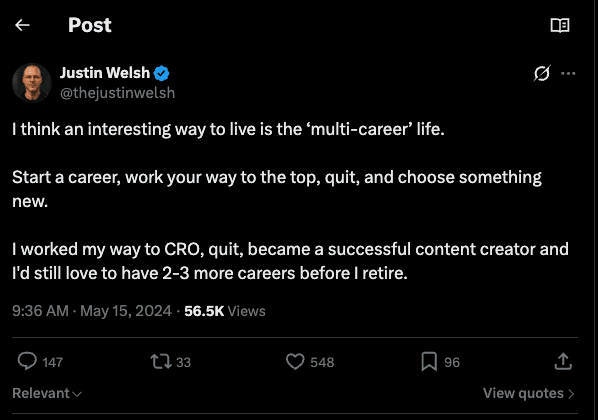
Justin Welsh is a good example. He built a successful career in SaaS, left it behind, and created an entirely different working life for himself. And he plans to go through this pattern again at some point.
That path is real.
But it isn’t the only one. Starting a new chapter doesn’t always require burning down the old one.
Even during my years in public service IT, I kept changing what I did. I moved through data analytics, infrastructure, project management, cloud, cybersecurity, management, and eventually executive leadership.
Same broad field, but very different crafts.
Each transition gave me something new to learn without requiring me to discard everything I already knew.
That distinction matters.
We often think of career change as starting over. In reality, very little of your experience disappears when you change direction.
- The judgment you’ve developed comes with you.
- Your ability to solve problems travels.
- Your understanding of people, organizations, incentives, technology, customers, risk, or whatever else you’ve spent years learning travels too.
The trick is figuring out what is portable.
When I left public service, people called it retirement. It wasn’t. It was another transition.
My interests had not shrunk. If anything, they had expanded. I wanted a kind of work that could hold more of them, while still making use of what I had learned over the previous few decades.
You may eventually decide to quit and build something entirely your own.
That remains a perfectly legitimate path.
But there are other paths:
- shift into a nearby domain where much of your judgment still applies.
- change roles inside the organization you already know.
- move to another organization where people already understand the value you bring.
- build something on the side while your current job continues to fund the experiment.
- stay in the same broad field while changing the craft entirely.
There is no rule saying a serious career has to make sense as one clean upward line.
In fact, I increasingly think range has value.
A career that looks confusing on paper may represent years of learning how different systems work, how different people think, and how to excel in unfamiliar territory.
That is not automatically better than deep specialization. Sometimes mastery requires staying with one thing long after the novelty wears off.
But the opposite mistake is very common: staying with something simply because you have already invested years in it. You know what to do, and it feels comfortable.
But for some of us, sameness can be expensive.
Continuous learning is one of my core values. I want a working life that gives me room to keep exploring, learning, and becoming useful in new ways.
And I suspect that kind of adaptability will matter even more in the years ahead.
AI is changing the economics of many kinds of work, and it is difficult to know which skills, roles, and business models will retain their value over the course of a 30- or 40-year career.
That makes career optionality more valuable.
I’m not arguing for constant reinvention. But range can be an asset: evidence that you can learn quickly, adapt to unfamiliar environments, and carry useful judgment into fresh problems.
A career does not have to be one identity stretched across your entire adult life.
It can be chapters.
And the chapters do not need to look alike to belong to the same story.
What to do this week
Give this ten minutes.
Write down three things:
- The next chapter you actually want to explore: a domain, craft, problem, or contribution.
- One way you could move toward it without blowing up your current life.
- One skill, form of judgment, or piece of experience you already have that would travel with you.
Then revisit the note a few times over the next week or two.
You may discover that the next chapter is not nearly as far away as it looks.
If you want a hand thinking through your specific situation, the Career Sovereignty Session is designed for exactly this kind of thing.