
The LinkedIn CEO wants you to upskill. I want you to ask a harder question.

The CEO of LinkedIn, Ryan Roslansky, wants you to adopt a “skills-first mindset.” He argues that jobs are just collections of tasks. Some AI will do, some it will assist with, and some will remain “uniquely human.”
His advice? Break your job down, automate the boring stuff, and upskill to stay relevant.
He’s right about the mechanics. But he’s dead wrong about why.
The Half-Truth
Roslansky is solving for the Job. How to keep doing what someone pays you to do in a world where machines can do a lot of it faster and cheaper.
That’s a real problem that we can’t dismiss.
But he’s missing the bigger question:
Why are you doing these tasks in the first place?
If you’ve been reading this newsletter for a while, you know I think there’s a critical distinction most people miss: the difference between your Job and your Work.
Your Job is what someone pays you to do. A collection of tasks. A contract. It ends when the paycheck stops.
Your Work is the contribution you’re here to make. The change you want to bring to the world. It doesn’t end, because it’s who you are.
Roslansky is redefining the Job. That’s useful.
But nobody’s talking about the Work. And that’s where it gets interesting.
Upskilling for the sake of “staying relevant” is just running faster on a treadmill someone else built. It’s a hardware patch for a broken Operating System.
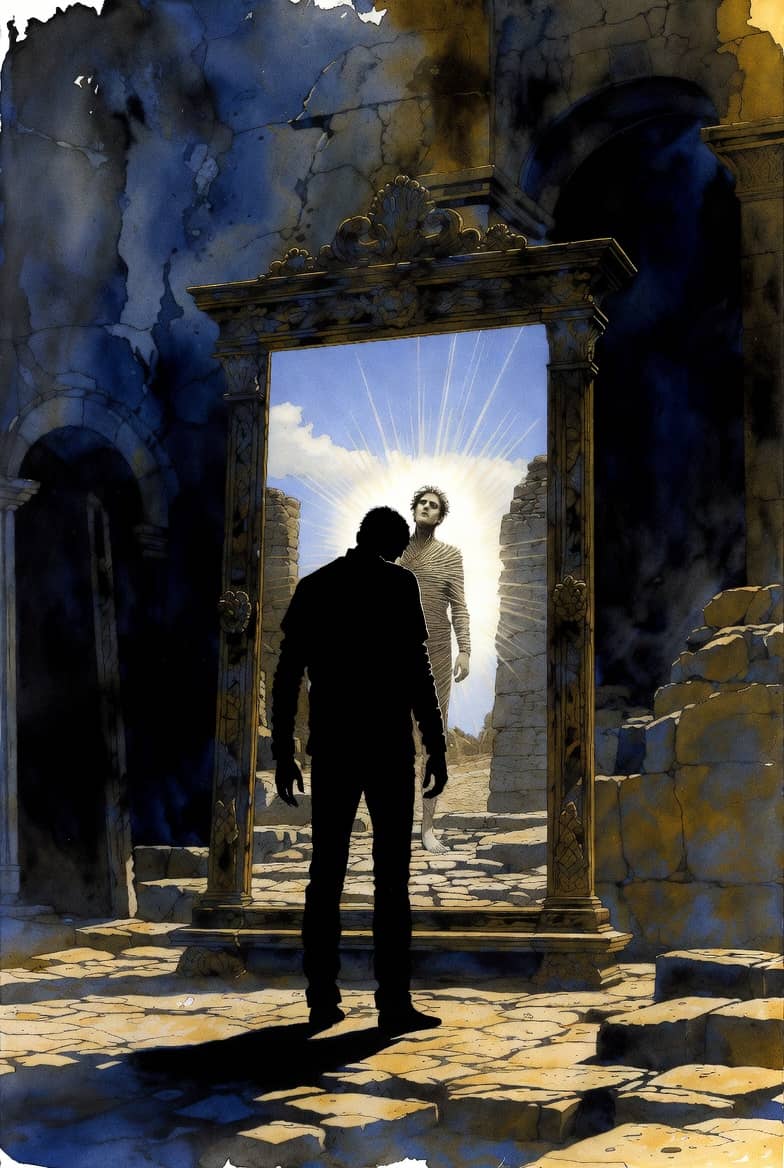
The Mirror in the Machine
There’s a lot of fear out there right now. Many people are wondering: “Will AI take my job?”
Fair enough. But what if you were to ask yourself a couple of tougher questions:
- “Have I been hiding behind busy-work that a machine is now able to do better than me?”
- “Who am I if I no longer do the bulk of my tasks because they’ve been outsourced to a machine?”
- “What is the unique value I add that no machine can add?”
If your entire professional identity is built on tasks — even complex, high-value tasks — then yeah, AI feels existential. Of course it does. You’ve spent two decades defining yourself by what you do, and a machine just showed up that can do a lot of it without needing coffee, sleep, or a performance review.
But that panic? It’s not really about AI. It’s about the fact that you never built anything beneath the tasks. You never figured out what you’re actually here to do. You just got really, really good at executing, and confused that with meaning.
AI didn’t create your mid-career crisis. It just stopped you from being able to ignore it.
My Own Reckoning
I’ve been playing a lot with AI tools, ever since generative AI came out. Not because some LinkedIn thought leader said I should “upskill.” Because I can’t stop.
I’ve been installing dev tools on my machine. Building things I couldn’t have built six months ago. Experimenting. Breaking things. Getting up way too early in the morning, because I’m excited to get going. I’m not doing this to “stay competitive.” I’m doing this because it’s the most creatively alive I’ve felt in years.
And once you start building with these tools, there’s no going back. Not because the old way is dead — but because you’ve seen what’s possible. You can’t un-see it.
But what’s interesting is why it feels so good. I’m not using AI to optimize my Job. I’m using it to accelerate my Work. To help me bring about the change I want to see in the world.
This newsletter? AI helps me think through ideas, structure arguments, and pressure-test my logic. But the ideas — the philosophy, the frameworks, the conviction that most people are trapped in jobs that are slowly killing them — that’s all mine. No machine is generating that.
AI is the most powerful tool I’ve ever picked up. But a tool in service of what? That’s the part most people skip — and it’s the most important piece of the puzzle.
What’s Actually Happening Here
I think AI is about to do something that no amount of self-help books, career coaches, or corporate retreats ever could.
It’s going to force millions of people to confront the difference between their Job and their Work.
When a machine can handle your tasks, you can no longer hide behind your tasks. You can’t define yourself by your efficiency, your throughput, your ability to produce slide decks at 11pm. That identity is getting automated away.
Which leaves you with a question you’ve been hiding from your whole career.
Without the tasks… who are you? And what are you actually here to do?
Most people don’t want to touch that question. That’s why the AI conversation is dominated by fear.
But for the people willing to sit with it? Being able to reflect deeply on that question unlocks the door out of the cage they’ve trapped themselves in.
Because the answer is your Work. And AI can’t touch it.
Three Kinds of People
Over the next few years, I think we’re going to see three very different responses to AI:
Group One buries their head in the sand, telling themselves that AI isn’t useful, that it’s just a fad that is going to go away. Stay in this group for too long, and you’re going to be in for a rough ride.
Group Two follows the Roslansky playbook. They upskill. They adapt. They learn the tools, break their jobs into tasks, and stay one step ahead of automation. They remain employable, highly efficient – but feeling empty inside. They’ve optimized the treadmill but still aren’t going anywhere. They chose the Job while ignoring their Work.
Group Three uses this disruption as the wake-up call it actually is. They ask the harder questions. Not “how do I stay relevant?”, but “what am I here to do?” They use AI to strip away the busywork — the “store-bought bacon” tasks — and create space for the contribution only they can make. They stop clinging to tasks and start building something that matters.
Group One suffers. Group Two survives. Group Three thrives.
I know which group I’m writing for.
Do Something With This
By all means, follow the LinkedIn advice. Break your job into tasks. Let the machine take the wheel on the boring stuff.
But then look at the tasks that are left. The ones no machine can replicate. The ones that require your judgment, your experience, your particular way of seeing the world.
Now ask yourself: Do those tasks light me up? Or are they just the ones that happen to be left over?
Because if the only reason you’re still doing them is that a machine can’t — that’s not your Work. That’s just the last tasks standing.
Your Work is the thing you’d do even if AI could do it. Because it’s yours.
AI is clearing your schedule. What are you going to do with the space?
Quotation I’ve Been Pondering
“The creation of something new is not accomplished by the intellect but by the play instinct.” — Carl Jung