
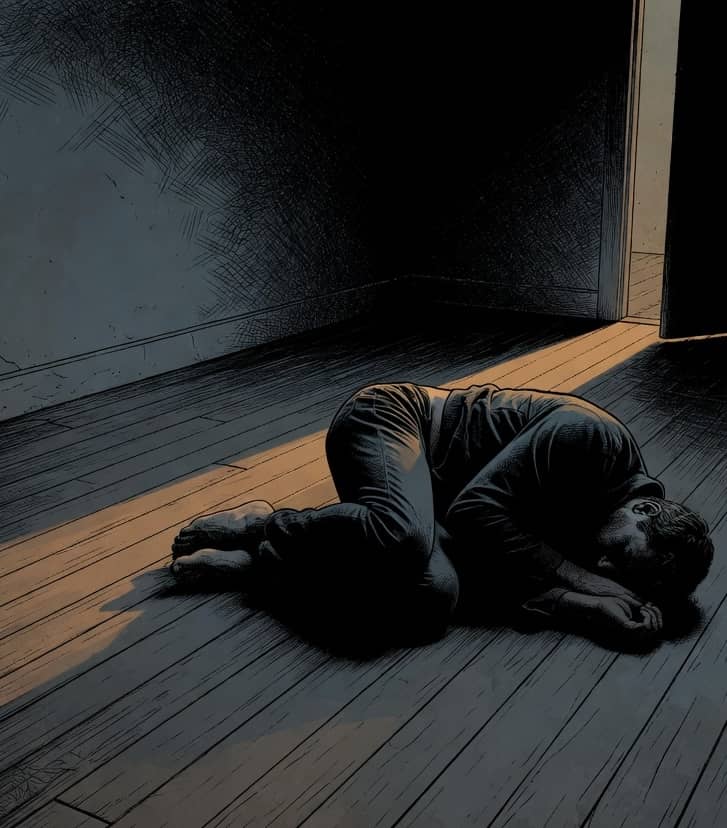

I was telling myself I just needed to go harder.
Lean in. Push through. Dig deeper. The project was slipping, the people around me weren’t moving fast enough, and somewhere in my head I had decided that if I just willed it hard enough, I could drag the whole thing across the finish line by myself.
Then one night I found myself on the floor. Curled up in a ball. In tears.
A couple of days later I was in the hospital.
And lying there, the thing I kept bumping up against — the thing I really did not want to admit — was that I couldn’t control everything. I had been operating like I could. And that mindset had just delivered me to a hospital bed.
That was the day Hero mode stopped working for me.
Three modes of being
There are roughly three ways people move through their lives. I think of them as levels, because you can move between them — and most of us do, sometimes by the hour.
- Victim mode. Life happens to you. You react. You blame. You wait for conditions to change before you can. The world is doing things, and you’re on the receiving end.
- Hero mode. You make life happen. You’re in control. You shape your reality through willpower and discipline. It’s all on you — and that’s exactly how you like it.
- Steward mode. You and life happen together, in a sort of dance. You shape what you can shape, and you respond skillfully to what you can’t. You’re responsible for the ground you tend, but you’re not pretending to control the weather.
Most of the personal development industry is selling you Hero mode, that if you would just finally level yourself up, you’d succeed. They’ll tell you it’s the top of the mountain. It isn’t. It certainly beats victimhood, which is where many people stay stuck. But it also bears a cost, one that many of the so-called “gurus” have never actually paid.
Why Hero mode seduces analytical people
If you’re the kind of person who reads this newsletter, Hero mode has probably worked for you.
It got you promoted. It got you the title, the salary, and the reputation as the person who delivers. It feels like maturity and being experienced. Like you’ve got grit. It feels like the opposite of being a victim (and it is). For many of us, escaping Victim mode is exactly the move that made our careers.
So we doubled down. Hero mode became identity. “I’m the one who makes shit happen!”
The trouble is, Hero mode confuses influence with control.
Stephen Covey drew a useful distinction here: the circle of control (what you can directly determine) and the circle of influence (what you can affect but not command). Hero mode treats both circles as if they’re the same circle. It assumes that with enough effort, anything in the influence circle can be pulled into the control circle.
It can’t. And the thing that finally teaches you that is usually expensive.
For me, it was a project I couldn’t will into delivery, a body that finally said no, and a hospital bed.
Steward mode has two faces
Hero mode is one rung up from Victim. Steward mode is the next rung up. It has two skills inside it, and you need both.
The Gardener
The Gardener tends the patch of ground they’re responsible for. They design the environment for good things to grow. They plant deliberately, and prune as required. And they accept that they don’t make the seeds grow, but know nothing good will grow without them.
This is your circle of control. Your habits. Your systems. Your nervous system regulation. The relationships you invest in. The work you choose to take on and the work you say no to.
Being a gardener is slow and unglamorous. Production takes patience and time, and you need to get your hands dirty. You plant now, and then trust that you’ll eventually harvest what you cultivated.
The Surfer
The Surfer rides what comes. They can’t make waves and they can’t calm the ocean. But they can read the water, choose their line, and use what’s actually there to move forward.
This is your circle of influence. The market shifts. The reorg. The people who don’t move on your timeline. Your own aging body. The economy. The thing your kid is going through.
When you’re in Hero mode, you try to will the wave away. To push it down. In Steward mode, you accept it and ride it.
The honest part
I’d love to tell you I consistently live in Steward mode now, having learned my lesson the hard way. I don’t. I’m still a work in progress.
These aren’t personality types, where you identify how you are in the world and are then stuck there. They’re levels. You don’t graduate from one to the next linearly, but move between them, depending on the situation. Stress and fatigue will drop you down. Fear certainly pulls you down. Awareness pulls you back up.
I still default to Hero mode under pressure. I’ll catch myself trying to will an outcome that isn’t mine to will, or carrying weight that belongs to someone else, or treating the influence circle like the control circle. Old grooves are deep and can be hard to shift out of.
The work isn’t arriving permanently at Steward mode. That might not even be possible — we’re human, and the lower modes are always within reach.
The work is noticing which mode you’re operating from, and choosing to climb when you’ve slipped.
That’s the practice. That’s it.
Which mode are you operating in?
Not which mode you aspire to. Not which mode you’d describe in a job interview. Which mode is actually behind your last three decisions?
If it’s Victim mode — what’s one thing in your circle of control you’ve been pretending isn’t yours?
If it’s Hero mode — what are you trying to will into existence that actually needs to be tended? Or ridden?
You can switch modes if you choose. But not until you see which one you’re in.